
Introduction
The Battle of Yates marked the beginning of the Expansion War, probably the darkest time in human history. There can be no doubt that the war forever changed the course of human history. For the first time, humans were forced to present a united front or face extinction from an outside force. During that time many prominent figures helped shape the human civilization we know today. One of the most famous of them is Admiral Thomas Raymond Novak.
A Commodore when the war broke out, he would rise to the rank of Admiral and become one of the first Council Members of the Colonial Confederation. The following is an abridged section of A Military History of the Expansion War, highlighting then Commodore Novak’s actions in commanding human forces in the Battle of Yates.
The Battle of Yates: November 22 – December 4, 3054
On November 14, 3054, sensors orbiting the remote Lindon Colony first detected the signs of fourteen unknown alien vessels approaching. This discovery would later be recorded as perhaps the darkest hour in the history of the human race, but at the time, it was heralded as one of the greatest. The unknown vessels tracking on sensors at a relative speed which to that point we had only seen with our own vessels. For the first time, it appeared humans had encountered an alien race that may have technology comparable to our own. In eight days the alien ships course and speed would bring them to the Yates System, home of the Lindon Colony.
The colony’s extremely remote location meant that any diplomatic support or military reinforcements were several weeks away. Ultimately the responsibility for contact fell to the Colonial Governor Janet Parsons, and to Commodore Thomas R. Novak, who commanded the colony’s small defense fleet.
For three days all possible attempts were made to contact the approaching forces, but no responses were ever received. The possibility had to be considered that we were dealing with an alien species whose methods of communication were so different from our own that the communication attempts had been unintelligible or even meaningless. But as the ships continued to close in on the colony the possibility of hostile intent could not be ignored.
On November 19, those concerns grew. The Ore Seeker II, a scout vessel for the colonial mining operation failed to return on schedule from a routine survey mission, and subsequent attempts to contact the ship went unanswered. Combined with the unknown forces approaching, the ships disappearance was enough to prompt Commodore Novak to place the colony’s defenses in a state of alert; a decision that was soon to be credited with saving many lives.
With limited ships and resources, there was no way to intercept the incoming ships before they reached the Yates System without sacrificing the security of the Lindon Colony. Commodore Novak made the decision to fortify defenses as much as possible, and then await an alien force whose intentions were unknown.
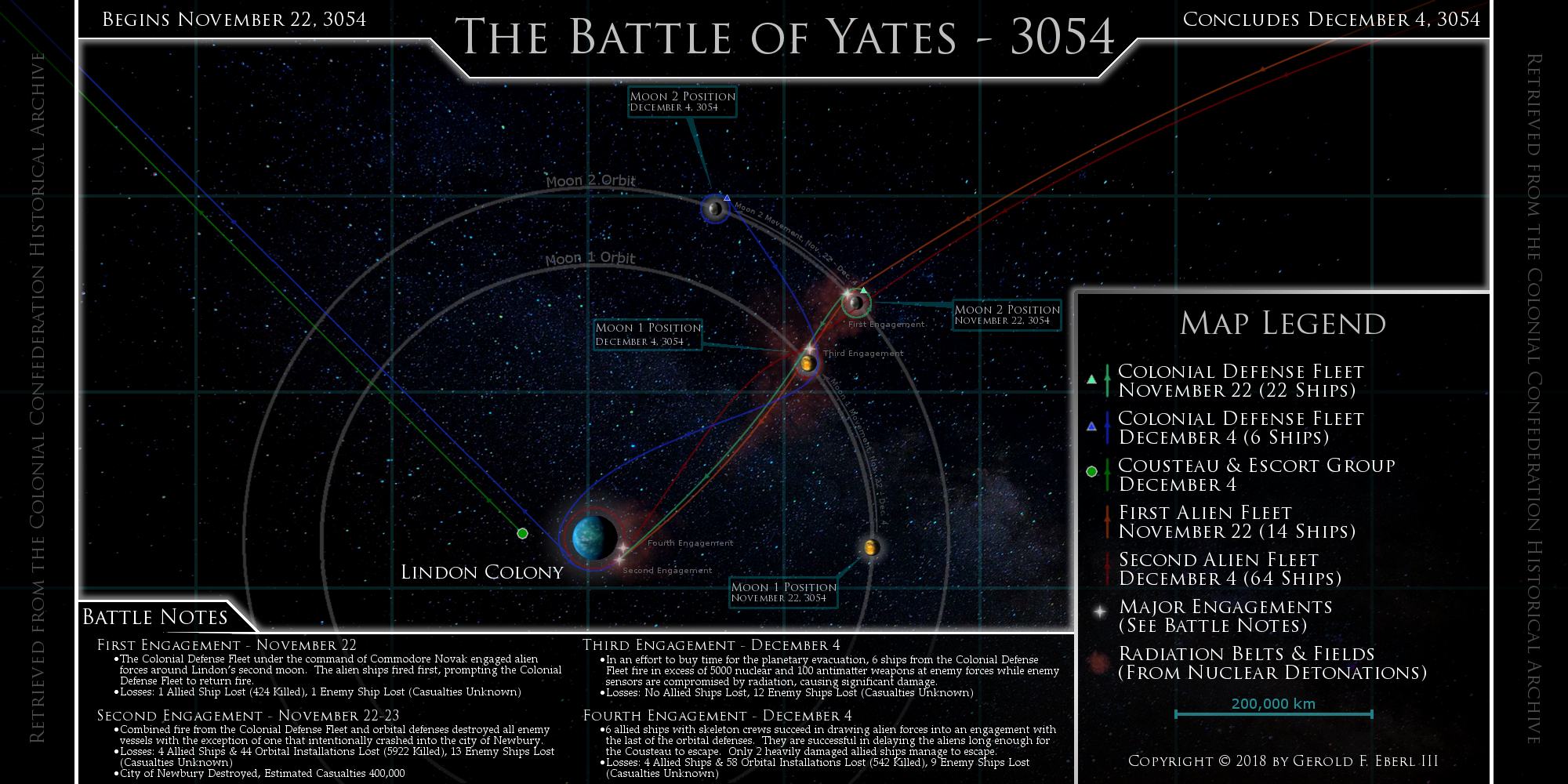
The fourteen alien vessels finally arrived in the Yates System on November 22, 3054, having never made any attempts at communication. Penetrating deep into the system before dropping to sublight speeds, their approach made little effort to conceal their hostile intent. Soon the first visuals of their vessels were seen by the crews serving on the twenty two ships and various stations that comprised the colonial defense forces. Overtly alien in design, the ships of the race we have come to refer to as the Cygnans traveled on a direct course towards the Lindon Colony. Commodore Novak’s forces moved to intercept them over Lindon’s second moon; their approach was immediately met with heavy fire from the incoming vessels.
It became immediately clear that the alien vessels were closely matched with our own from a technological standpoint. The battle raged as the alien forces continued to drive closer to Lindon, ignoring attempts to draw them into a protracted engagement. Despite the numerical superiority of Lindon’s forces, heavy losses were incurred. The sheer ruthlessness of the Cygnan forces is captured in Commodore Novak’s log following this first engagement.
Excerpt from the log of Commodore Novak:
Fleet Commander’s Log, Commodore Thomas Novak, November 23, 3054.
We engaged in battle with the unknown alien force mentioned in my previous log entries. Their initial approach was highly provocative; the defense fleet moved to intercept them over Lindon’s second moon, where they immediately engaged us. Technologically they appear comparable to us, but their savagery is on a completely different level.
Our engagement began with a fairly ordinary exchange of fire, but it quickly became apparent that we were dealing with truly alien military philosophies. Quite early in the battle they sacrificed one of their vessels to break through and push towards Lindon. With the damage their ship had sustained we considered any threat it posed to be neutralized and focused on the remainder of their forces; that proved to be a mistake.
Rather than withdrawing from the engagement, their damaged ship made a suicide run, taking the destroyer Farkland with it. At that point it became clear that they would fight to the last, and I ordered our forces to give no quarter.
Over the next hour we continued to exchange fire until both fleets settled into orbit around Lindon. It was then that the alien forces began to fire on the surface, at times sacrificing their own defense to do so. They made no distinction between military and civilian targets, if they even had such concepts. Most of their attacks were intercepted by surface defenses, but a number of nuclear devices impacted the surface in some outlying areas. We are still tallying casualties and evacuating survivors from the affected areas. However, that was not the worst of it.
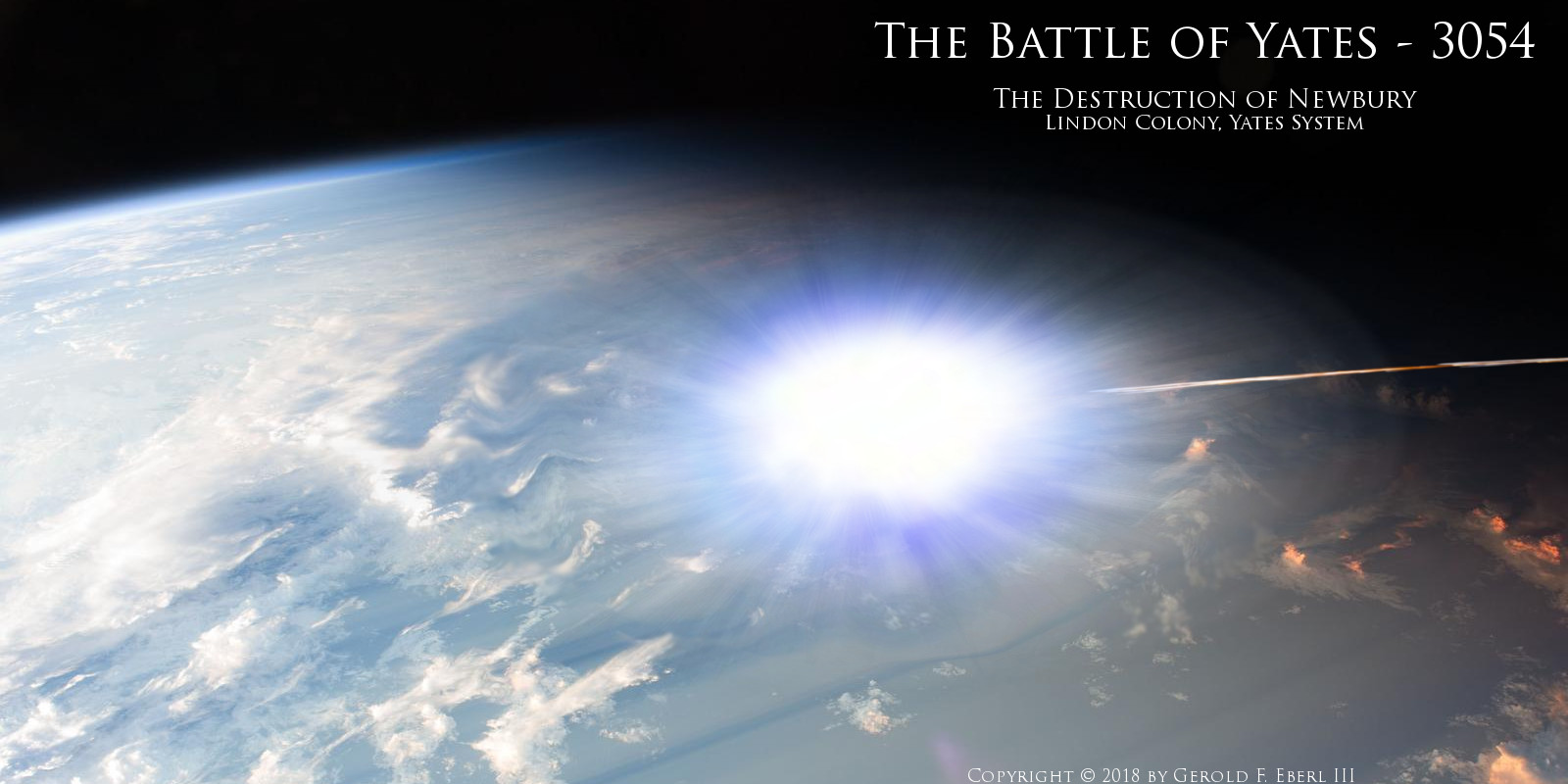
As we destroyed their vessels, several of them intentionally deorbited, attempting ballistic reentry aimed at cities on the surface. While we were able to destroy or alter the course of most of them, one of their larger vessels hit on the outskirts of Newbury, a city of over four hundred thousand. Between energy of the impact and whatever weapons the ship was still carrying the resulting blast was several gigatons, the city was effectively wiped out.
The current status of the Lindon Defense Force is also not good; I estimate our current combat strength at no more than half. Five ships and forty four orbital defense satellites were lost in the engagement. Lost ships included one cruiser, one destroyer, and three frigates. Four other vessels sustained heavy damage and will not be combat worthy any time soon.
The only remotely positive outcome of this battle has been that we have recovered a portion of one of the enemy vessels that was broken off in the fighting. We are currently analyzing the technology it contains, as well as several alien remains. I have sent all of our data so far to Command and requested any available reinforcements, but due to Lindon’s remote location and signal delay I do not expect a response for at least a day.
The results of this engagement prompted an unusually swift response from the nations of Earth. For the first time, it was possible the human race faced a true threat from an outside force. On November 26, 3054, several fleets were dispatched to reinforce Lindon and investigate the threat posed by these unknown aliens. However, because of the colony’s location it would take nearly two weeks for the first of these fleets to arrive. This would prove to be time Lindon did not have.
That same day, the Lindon Colony’s sensors picked up another group of alien vessels moving toward the colony. This time there were over sixty vessels; a force sufficient to easily overwhelm the remaining defenses and destroy the entire colony. With knowledge of the forces coming towards the colony, Commodore Novak, for the first time in human history, ordered a planetary evacuation.
The order to evacuate was rife with complications, a panicked populace, damaged infrastructure, and the greatest impediment, too few ships capable of interstellar travel. In the century since its founding the population of Lindon had swollen to over ten million, the ships available, both military and civilian, could not even carry half of that.
Only heroic efforts by the planetary government prevented the situation from descending into a planet wide riot. It was quickly decided to prioritize the evacuation of children and the younger members of the populace. A large number of people actually volunteered to remain, knowing it meant almost certain death.
Yet through a stroke of genius, most of the people of Lindon would be spared the tragic fate it seemed awaited them. Zachery Newsome, an engineer for the Lindon Power Authority, devised a plan to use the Cousteau, the original colony vessel that had brought the first settlers.
While still largely intact, the Cousteau, had been converted to serve as an administrative hub for the early colony, and it now stood at the heart of the capital city as a government office and museum. It had not been space worthy in almost a century; and while theoretically capable, it was never intended to be launched back into space. But if it could be launched it could sustain nearly five million people for a short time, long enough to get to safety.
In a frenzied act, driven by almost unfathomable desperation, the full resources of the colony were directed to a singular purpose, the restoration of the Cousteau. While the youth of the colony fled, those that remained gathered in the capital and worked in a desperate race against time to make the ship space worthy.
Though he lent all available resources to the effort, Commodore Novak was fully aware that the chances of restoring the Cousteau to flying condition in 8 days were slim, even with the full efforts of the planet devoted to it. The days passed, and Novak’s own words as the alien fleet closed in convey the desperation and hopelessness of the colony.
Excerpt from the log of Commodore Novak:
Fleet Commander’s Log, Commodore Thomas Novak, December 3, 3054.
It is entirely possible this will be my last log entry. An alien fleet of over sixty vessels will attack us in less than twenty four hours, against it, we have no hope. Efforts to launch the Cousteau continue, but if they fail, it will seal the fate of over five million people stranded on Lindon’s surface.
I have ordered most military personnel to the ships that will serve as the Cousteau’s escort if it successfully launches, or flee if it fails. Either way, we will wait until the last possible second before running. Current projections have work on the Cousteau being completed with about five hours to spare, but that does not leave much time to work out any difficulties that arise. That ship hasn’t been powered up in over a hundred years, there are bound to be difficulties. My ship and a few others, operating with skeleton crews of volunteers will serve as a distraction if necessary; if it comes down to that, perhaps we can buy them a few minutes.
I have forwarded all logs and records to command, we need to be ready. Given what I’ve already seen and what’s coming, I don’t think it’s an exaggeration to say we’re at war. This enemy doesn’t want to talk to us, doesn’t care about talking to us, it only want’s us destroyed, and we have no idea why. Not that it matters, humans have always been survivors. We’ll survive this.
Clearly our enemies are intelligent beings, but if all they want to do is kill us then they might as well be a virus. If our first encounter is an accurate representation of what to expect, we cannot afford to show mercy, or have pity. I’m sure some would find that, too harsh, warn me about being no better than our enemies, but I remember the words of Admiral Holloway, “Even if you are willing to die for your ideals, you have no right to take other people with you.”
Whatever it takes, we have to win.
As Novak anticipated, the Cousteau’s century of inactivity had taken a toll; a number of power distribution systems failed when the reactors were turned on. Repairs delayed the launch, but in what is regarded by some as one of the miracles of the Expansion War, the ship was able to lift off and escape as the Cygnan fleet began to encircle the planet.
Commodore Novak’s forces succeeded in delaying the enemy fleet over twenty minutes by drawing their attention to targets on Lindon’s first moon and the far side of the planet. These twenty minutes were essential in allowing the Cousteau to escape without being attacked, and are thus credited with keeping the total casualties in the Battle of Yates under a million.
Though it took heavy damage, Novak’s ship successfully escaped the battle and joined with the rest of the evacuees. The Commodore was seriously injured in the battle and would spend the first two months of the war recovering. But his actions during the evacuation of Lindon did not go unnoticed, earning him the Medal of Valor and a promotion to Rear Admiral. He was to play a pivotal role in the war to come.
By the time any human fleets reached Lindon the planet had been reduced to an uninhabitable wasteland by sustained orbital bombardment. It was a grim preview of things to come.

